
Stronger does not always start with heavier.
When many people picture strength training, they picture a barbell loaded with plates. They imagine lower repetitions, heavier weights, and the satisfying feeling of adding another five or ten pounds to the bar.
We understand the appeal. Heavy barbell training is valuable, effective, and it can be fun.
But lifting heavy is not the only way to get stronger.
For the next six weeks here at OSi, we are intentionally stepping away from the barbell and returning to two simple, foundational movements:
-
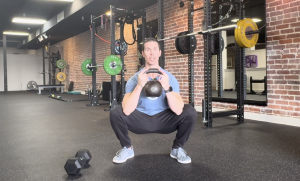
- ”Pretty” Goblet Squats
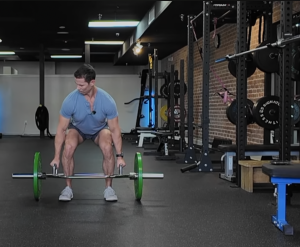
- Silverback Deadlifts
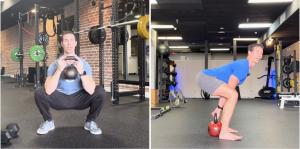
Instead of performing a few heavy repetitions, we will be performing sets of 20 controlled, high-quality reps.
This change is not a step backward from former weeks of heavier barbell lifts, it’s an opportunity to build strength differently.
Can Lighter Weights Really Build Strength?
Yes.
Resistance training with lighter loads can improve strength, build muscle, and increase muscular endurance—especially when the sets are challenging and performed with consistent effort.
Original Strength Institute co-owner and coach, Tim Anderson, who wrote our current training program shared, “Lighter weights can build significant strength and muscle mass if they are used appropriately. Studies show just 30% to 80% of a person‘s one rep max is what it takes to create muscle growth, using rep ranges between 5 to 30 reps.“ Tim also noted that, “These studies show that there is no difference in the muscle growth that can be created between loads of 30% and 80% of a one rep max. The difference with a 30% load is that it allows you, or requires you, to perform more repetitions to achieve more time under tension.” Another benefit of the lighter load is that it allows you to move through a full range of motion with more control and with less stress on your joints.
And we are all about offering people the opportunity to move and feel good without over-stressing the joints all the time.
There are tradeoffs and benefits with all forms of loading strategies. But there are also diminishing returns. The body responds (grows) through challenge and adaptation. The body also strives for homeostasis (meaning it is going to adapt). This means that the stimulus should and must change over time. To do the same thing is to get the same thing. To inspire change, there needs to be a change.
Heavy weight training stimulates Type 2 muscle fibers.
Lifting around 80% loads relative to a one rep max tends to produce greater improvements in maximal, one-repetition strength. This style of training makes sense: if your goal is to become better at lifting the heaviest possible weight one to three times, then you need regular practice lifting very heavy weights. However, lighter and moderate loads can still produce meaningful strength gains while also developing muscular endurance and supporting muscle growth. This is because lighter loads lifted for more repetitions stimulates Type 1 muscle fibers.
The lesson is not that lighter weights are better than heavy weights.
The lesson is that both are useful tools. DO BOTH.
A strong program does not depend on one tool forever. It changes the training stimulus so your body continues to learn, adapt, recover, and improve.
Why Sets of 20?
Twenty repetitions give you something a set of three may not:
More time to practice.
During a long set, you have repeated opportunities to find your feet, organize your posture, control your breathing, and notice how your movement changes as fatigue begins to build.
The first five repetitions may feel easy.
Repetitions 10 through 15 require more attention.
By repetitions 16 through 20, your body has to work much harder to maintain the same posture, range of motion, and control.
That is where the set becomes especially educational and fruitful.
Can you continue to sit between your legs in the Goblet Squat with good posture?
Can you keep your torso and legs connected during the Silverback Deadlift?
Can you breathe while maintaining tension?
Can you keep the twentieth repetition as intentional as the first?
The weight may be lighter than what you would place on a barbell, but the set should not be careless or easy. You are creating difficulty through repetition, time under tension, range of motion, and movement quality.
You are asking your body to adapt through uncomfortable struggle. You are literally asking for strength.
Lighter Does Not Mean Easy
There is an important difference between using a lighter weight and using a weight that is too light to challenge you.
For this block, choose a kettlebell you can control for a meaningful number of repetitions while still having room to progress.
Your set should require focus.
Your breathing should change.
The final repetitions should feel more demanding than the first few.
But your movement should remain recognizable and controlled.
You should not have to twist, bounce, rush, or shorten your range of motion simply to reach 20.
The goal is to approach fatigue without allowing fatigue to take over the movement.
When you can complete all prescribed sets for 20 quality repetitions, move up to the next kettlebell size. You may not reach 20 immediately with the heavier bell, and that is okay.
Build back toward it.
That is progressive overload.
This is hard.
You are asking your body to do more over time. You are simply progressing through better repetitions and gradually increasing kettlebell size rather than adding weight to a bar every week.
From Tim, “This is how you make muscles grow, moving through the full length and stretch of the muscles while under tension. Done well, this will not be easy. The juice is worth the squeeze, though. Stronger muscles, stronger tendons, happier joints.”
Why are we telling you all of this? Why Step Away from the Barbell?
We’ve heard their may be concerns about not lifting as heavy as we have been previously. And we get that, but breathe. This could help you achieve so much more than extra weight on a barbell, but it can also actually help you put extra weight on a barbell…
Anyway, the barbell is an excellent strength-training tool, but every tool creates certain opportunities and certain limitations.
A barbell allows us to load movements heavily and make small, measurable increases. That is one of its greatest strengths.
A kettlebell offers a different experience.
Holding a kettlebell in front of the body during a Goblet Squat can provide feedback that helps you sit more comfortably between your legs, stay connected through your trunk, and explore a fuller squat.
The Silverback Deadlift changes the relationship between the weight and your body. Because the bell begins nearly behind you, you have to connect your legs and torso, create tension, and drive through the floor with intention.
Neither movement is meant to imitate a barbell lift perfectly.
That is the point.
Changing the equipment changes the problem your body has to solve.
A different problem can reveal:
- Where you lose tension
- Where you rely on momentum
- Where your mobility limits you
- Where one side works differently from the other
- Whether you can maintain good movement as fatigue builds
Stepping away from the barbell also gives us a chance to stop judging every session by the amount of weight lifted.
For six weeks, progress can be measured differently.
Can you squat deeper?
Can you control the descent?
Can you maintain your posture for all 20 repetitions?
Can you use a heavier kettlebell without losing your movement quality?
Can you finish the set feeling challenged rather than disorganized?
Can you grow muscle?
Those are real strength improvements.
We are implementing “Same but Different” training variety, not randomness
Changing the training stimulus does not mean abandoning the fundamentals.
You will still squat.
You will still hinge.
You will still stabilize your midsection, breathe, and produce force.
You are simply practicing those qualities with different loads, positions, repetition ranges, and tools.
That distinction matters.
Random exercise selection creates novelty without direction. This means effort without results.
Thoughtful variation keeps the goal consistent while changing how we pursue it.
This block is not six weeks away from strength training.
It is six weeks of building a broader expression of strength.
Then, when the barbell returns, you may bring better positions, more muscular endurance, greater body awareness, and a renewed appreciation for heavy lifting with you.
Strength Is More Than a Number
A one-repetition maximum tells us something that is debatably useful: how much weight you can lift once in a specific movement. “Debatably” because absolute strength does not necessarily improve quality of life. But enduring strength does.
Strength’s purpose is to make your life better.
Strength includes the ability to:
-
- Repeat an effort without losing your position
- Control your body through a full range of motion
- Create tension and breathe at the same time
- Move confidently on and off the floor
- Stand up with power
- Coordinate your arms and legs
- Adapt when the movement, object, or environment changes
That is why this block includes more than Goblet Squats and Silver Back Deadlifts.
Rolling, rocking, crawling, Hopscotch, Hanging Knee Raises, Dead Bugs, planks, and Box Squat Jumps all ask you to organize and use your strength in different ways. These are foundational to having a great quality of life.
Yes, absolute strength matters.
But so does coordination, muscular endurance, mobility, power, and control.
We want all of them.
Your Six-Week Challenge
For the duration of this block, we challenge you to stop asking only:
“How heavy was it?”
Start asking:
“How well did I move it?”
After each workout, record one movement-quality win.
It might be:
-
- I reached a deeper squat without forcing it.
- My final five reps looked better than last week.
- I completed my knee raises without swinging.
- I maintained full-body tension during every plank.
- I moved up a kettlebell size and stayed in control.
- My rocking felt smoother.
- My Box Squat Jumps felt more powerful.
- I left the session feeling better than when I arrived.
At the end of six weeks, look back at those notes.
The number on the kettlebell may have increased but you may also discover that your definition of progress has become much bigger.
What Success Looks Like
By the end of this block, success may look like:
- Completing more quality repetitions
- Moving up to a heavier kettlebell
- Squatting through a fuller range of motion
- Maintaining better posture under fatigue
- Feeling stronger through your midsection
- Moving with less stiffness
- Improving coordination and balance
- Feeling more confident without a barbell in your hands
- Bigger guns and thighs. Just kidding, but also not kidding…
We will return to heavier loading and barbells.
When we do, the goal is not simply to pick up where we left off.
The goal is to return as better movers—more connected, more aware, and more capable of expressing the strength we have built.
Heavy weights are valuable. Lighter weights are valuable.
The skill is knowing when and why to use each one.
For the next six weeks, embrace the change.
Own your repetitions. Notice what improves.
So here’s our challenge to you:
For the next six weeks, don’t judge your workouts by the weight you lift.
Judge them by the quality of your movement.
Then, at the end of the block, ask yourself one simple question:
“Am I more capable today than I was six weeks ago?”
If the answer is yes, you’re doing exactly what strength training is meant to do.
If you’d like some guidance along the way, we’d love to help. Whether you join us in person at Original Strength Institute or train from anywhere with OSI Online, you’ll experience programming designed to help you move better, get stronger, feel better, and stay capable for life. We hope you’ll join us.
>> Train in person at Original Strength Institute in Fuquay-Varina
>> Train online with us at OSI Online